Flexible-workspace B2B company · 2025–26
AI email personalization engine
A three-stage AI pipeline that writes a personalized email only when the data supports one, and skips the contact when it doesn't.
The problem
Outbound personalization was either manual or templated. Manual was slow and depended on the SDR. Templates got low reply rates. We wanted per-contact personalization at scale, but only when the data justified it. It also couldn’t depend on RevOps running a batch.
What I built
An SDR adds a contact to a sequence. That fires a webhook and routes the contact one of three ways: run the AI pipeline, enrich first and then re-route, or go straight to a call-only list.
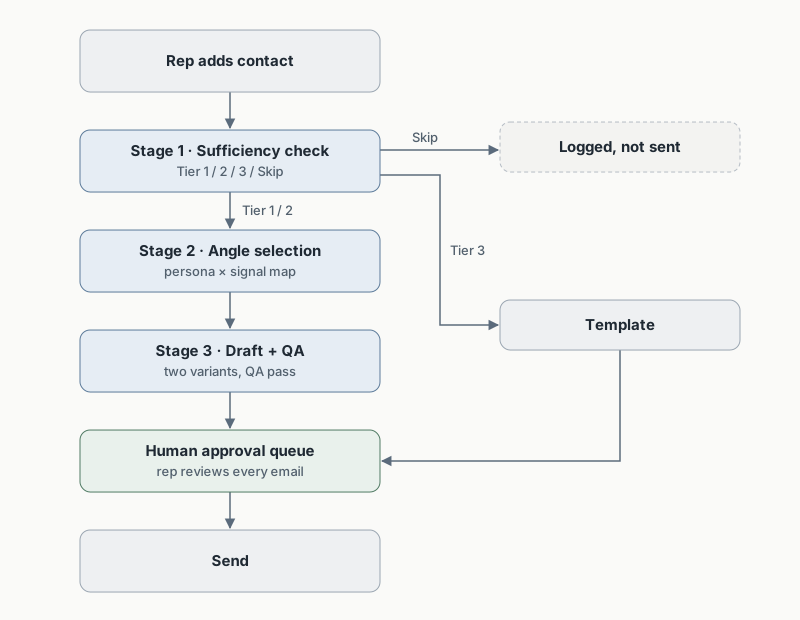
The AI pipeline has three stages.
- Stage 1: sufficiency check. Reads the enrichment data, classifies the persona and assigns a tier: 1, 2, 3 or skip. Tier 3 gets a template. Skip is logged with a reason.
- Stage 2: angle selection. Picks the angle from a 24-entry map keyed by persona and signal. Each entry holds the product emphasis, key message and proof points.
- Stage 3: email generation. Writes two different variants and runs automated QA on word count, banned words and subject lines.
Drafts land in an approval queue. Every path ends in LinkedIn and email sequencing by SDR owner.
Design decisions
- Not every contact deserves an AI email. Thin data gets a template or a skip, never a weak AI email.
- Every stage outputs structured JSON, so routing is deterministic.
- Product context is injected per persona and signal, which keeps prompts short.
- SDRs trigger it by doing what they already do. No new tool to learn.
- Nothing sends until a person approves it.
Result
Any SDR can start personalized outbound by adding a contact to a sequence. Each email is either personalized to the prospect’s situation or not sent. The AI cost runs about $10 to $20 per 250 contacts.